KKS
Kraftwerk-Kennzeichensystem
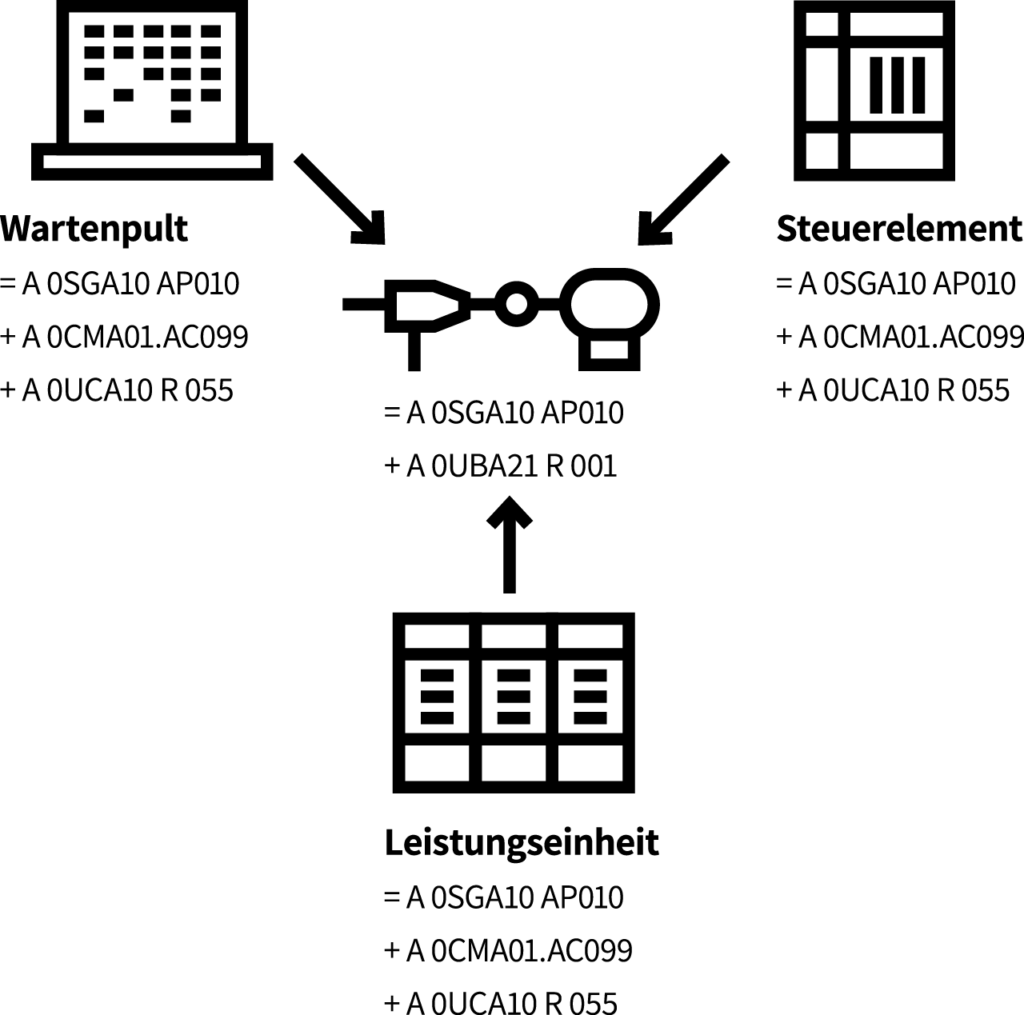
Das Kraftwerk-Kennzeichensystem (KKS) ist ein System zur Kennzeichnung von Anlagen, Systemen, Teilsystemen, Geräten, Elektro- und Leittechnischen Schränken sowie Gebäuden und Räumen je nach Sichtweise der Betreiber einer Kraftwerksanlage. Die Anwendung dieses Anlagenkennzeichnungssystems ist durch die Richtlinien des VGB PowerTech e.V geregelt und vorgeschrieben.
Das KKS bildet außerdem die Grundlage einer verlässlichen Anlagendokumentation.
Zur Anlagenkennzeichnung werden im KKS 15- bis 17-stellige Buchstaben- und Ziffern-Kombinationen verwendet. Die enthaltenen Buchstaben dienen der Klassifizierung von Systemen und Aggregaten im Kraftwerk. Die verwendeten Ziffern werden zum Zählen verwendet.
The KKS plant identification system distinguishes three types of identification:
-
Process engineering identification:
Used to identify plants and equipment within the power plant process. -
Installation location identification:
Used to identify installation locations and mounting positions in electrical and control systems. -
Physical location identification:
Used to identify buildings and rooms.
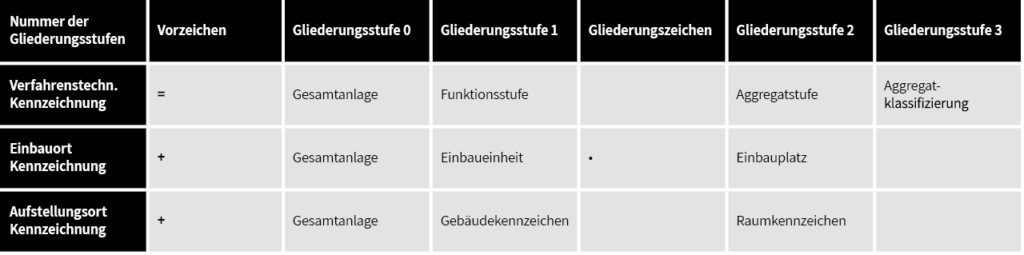
| Hierarchy level number | Prefix | Hierarchy level 0 | Hierarchy level 1 | Separator | Hierarchy level 2 | Hierarchy level 3 |
| Process engineering identification | = | Overall plant | Functional level | Equipment level | Equipment classification | |
|---|---|---|---|---|---|---|
| Installation location identification | + | Overall plant | Installation unit | • | Installation location | |
| Physical location identification | + | Overall plant | Building identification | Room identification |
Identification according to the Power Plant Identification System (KKS) is structured into four alphanumeric hierarchy levels, numbered from 0 to 3.
The further to the right the identifier is read, the greater the level of detail it provides.
This example illustrates the structure of a KKS identifier from a process engineering perspective. Identification can also be carried out according to the installation location and physical location identification types.
For illustrative purposes, we use A as a placeholder for letters and N for digits. A space indicates the separation between the individual hierarchy levels.
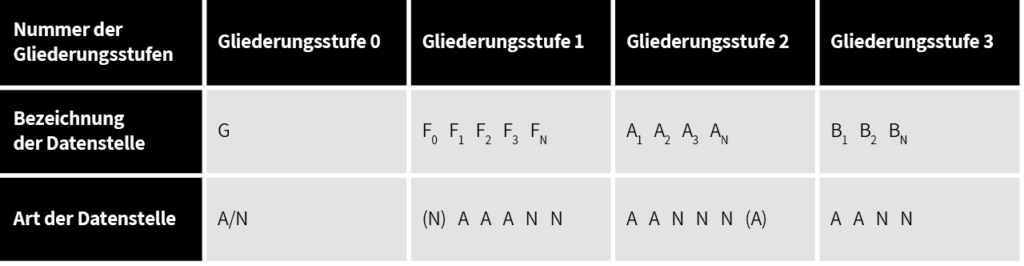
| Hierarchy level number | Hierarchy level 0 | Hierarchy level 1 | Hierarchy level 2 | Hierarchy level 3 |
| Data field designation | G | F0 F1 F2 F3 F4 FN | A1 A2 A3 AN | B1 B2 BN |
|---|---|---|---|---|
| Type of data field | A/N | (N) A A A N N | A A N N N (A) | A A N N |

Free Quick Check of Your Plant Documentation:
With our Quick Check, you can get an initial assessment in just 5 minutes. Free of charge and with no obligation.
The Hierarchy Levels of the Identification System
KKS Hierarchy Level 0: Overall Plant
This hierarchy level describes the overall plant within the identification system. It is used for numbering and for identifying the power plant unit or block. A digit or a letter may be used for this purpose.
KKS Hierarchy Level 1: Functional or System Identification
Hierarchy level 1 identifies systems/subsystems and functions within a power plant unit.
It consists of three letters (the system classification), two digits (the system numbering), and optionally a leading digit (the prefix of the system identifier).
Systems within power plants are represented by letters and assigned using a defined key:
- First letter: Main systems or main groups
- Subsequent letters: Subdivision into subgroups
This is followed by two digits for system numbering.
KKS Hierarchy Level 2: Equipment Identification
This level identifies equipment within a subgroup. It consists of two letters (the equipment classification) and three digits (the equipment numbering).
The letters represent equipment within the power plant and are also assigned using a defined key:
- First letter: Equipment group
- Second letter: Subdivision into a subgroup
The three digits for equipment numbering follow. An additional letter may be appended as a supplementary identifier for the equipment code.
KKS Hierarchy Level 3: Component / Signal Identification
The final hierarchy level is used to identify a component in the sense of an operating resource. Alternatively, it identifies a signal within the equipment.
It is shorter than the preceding levels and consists of two letters (the component classification) and two digits (the component numbering).
Structure:
- First letter: Device group
- Second letter: Subdivision into a subgroup
The following digits are used for numbering.
Signal identifiers are assigned in a predefined manner.